


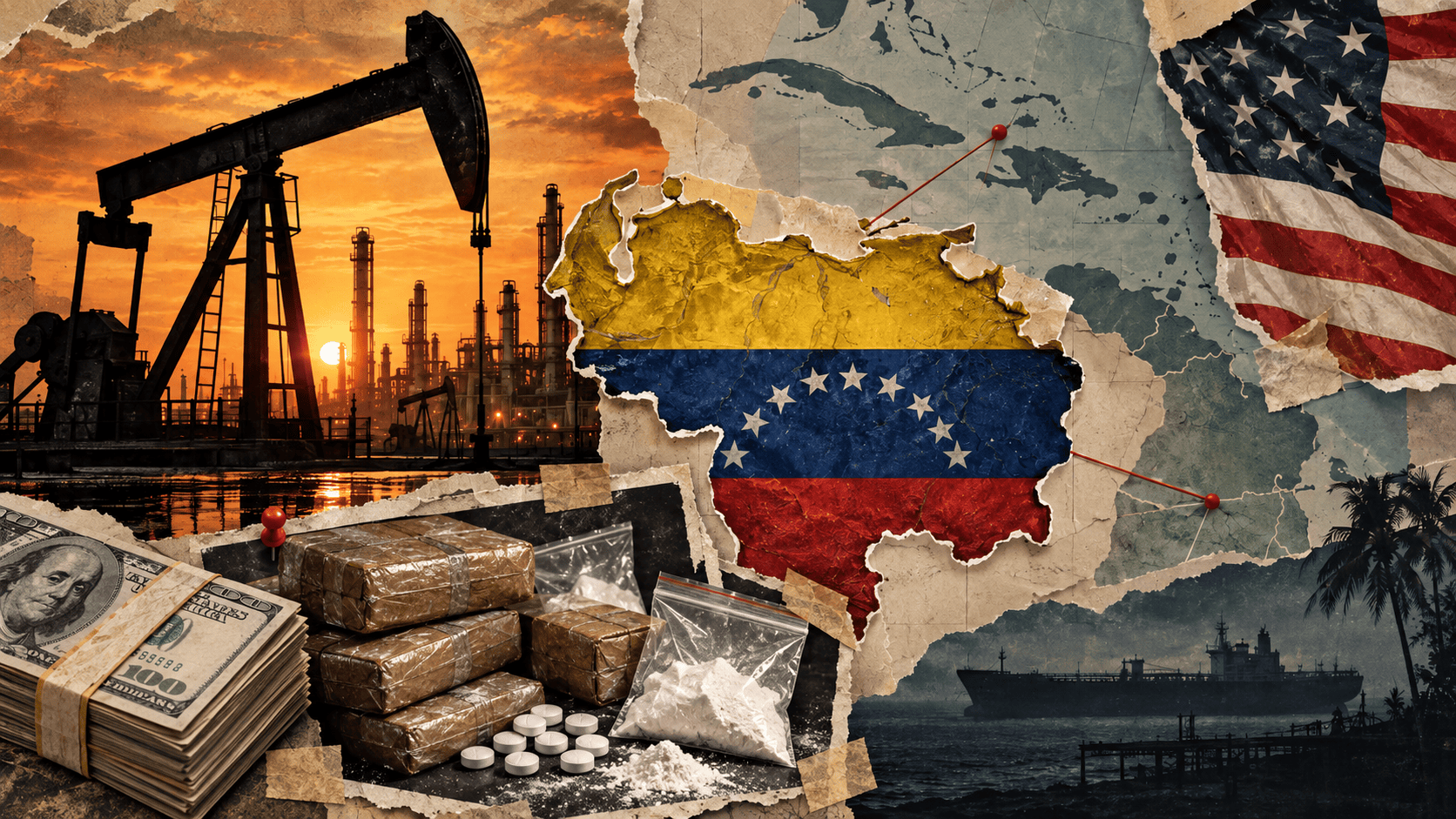
Washington has removed Venezuela from the group of countries deemed to have “failed demonstrably” in their anti-drug obligations while maintaining it on the broader list of major drug-transit and producing countries, citing growing cooperation with Delcy Rodríguez’s interim government. At the same time, U.S. oil companies and policymakers are rapidly deepening their involvement in Venezuela’s enormous crude reserves, raising questions about how energy, counternarcotics policy and Washington’s broader geopolitical strategy now intersect.
Since 2005, when former President Hugo Chávez was still governing Venezuela, Washington has presented the Latin American country as a central concern in its regional anti-drug policy. That has just changed.
On September 16, U.S. President Donald Trump announced that Venezuela was no longer among the countries Washington considers to have “failed demonstrably” to meet their international drug-control obligations, as reported by Diario Red. Venezuela, however, is still considered a major drug-transit or illicit drug-producing country—a different category that does not, by itself, imply that its government is failing to meet its anti-drug commitments.
How did Venezuela go, in a matter of months, from occupying a central place in the U.S. narrative on drug trafficking to being led by a government whose anti-drug cooperation Washington is highlighting?
This shift comes as another relationship central to both countries is also changing: oil.
From Adversarial Relations to Renewed Cooperation: What Happened to the Anti-Drug Narrative
To understand what changed, we first need to separate two classifications that are often confused. Every year, the president of the United States identifies countries considered major drug-transit or illicit drug-producing countries; this is known as the Major’s List. Venezuela remains on it: it’s one of the 23 countries included in the determination for fiscal year 2027.
But appearing on that list does not, by itself, mean that Washington believes the government of that country is failing to combat drug trafficking. The State Department has explained that the designation may be based on geographic, commercial, and economic factors that facilitate drug production or transit even when authorities implement control measures. The “failed demonstrably” category is different: it applies when the president determines that a country has failed to make substantial efforts to meet its international anti-drug obligations during the previous 12 months.
Here’s the relevant change. In September 2025, the White House included Venezuela, along with Afghanistan, Bolivia, Burma, and Colombia, among the five countries that had “failed demonstrably” to make those efforts. One year later, the list was reduced to four: Venezuela disappeared from that second classification, although it remained on the Major’s List.
Trump explicitly attributed that decision to the new relationship with Delcy Rodríguez’s interim government. In the determination sent to Congress, he argued that political changes in South America had opened new possibilities for cooperation and said Washington was already seeing results from its joint work with Caracas against cartels. “Given the positive steps” under Rodríguez, he said, Venezuela should no longer be considered a country that had demonstrably failed to meet its anti-drug commitments.
In September 2025, the Trump administration launched a military campaign in the Caribbean against vessels it claimed were linked to drug trafficking. The first known attack, on September 2, killed 11 people aboard a vessel from Venezuela; Trump said they belonged to Tren de Aragua and were carrying drugs, but at the time the U.S. government did not publicly release evidence about the identities of those on board or the cargo. Various experts, politicians, and news outlets questioned the legality of summarily killing people suspected of drug trafficking instead of arresting them.
Still, the campaign continued. On September 15, another U.S. attack on an alleged Venezuelan drug-trafficking vessel killed three people; once again, Trump did not publicly present evidence showing that the vessel was carrying drugs. By October, several similar attacks had already taken place.
And then came the decisive change: in January 2026, the United States captured Nicolás Maduro and Delcy Rodríguez took charge of the interim government. From that point on, Washington began working directly with that administration. Reuters describes the current situation explicitly: Trump attributed Venezuela’s removal from the “failed demonstrably” category to the results of cooperation with the Rodríguez government. The government Washington was dealing with had changed, and the bilateral relationship shifted dramatically with it.
So What Happened to the ‘Cartel of the Suns’?
Washington’s shift in tone raises another important question: what happened to the so-called “Cartel of the Suns,” a structure that the U.S. government itself presented for years as a drug-trafficking organization run from the highest levels of the Venezuelan state?
It is worth separating several things that are often conflated. One is the existence of drug-trafficking and corruption allegations against specific Venezuelan officials. Another is the allegation that state protection or corruption networks were linked to drug trafficking. And another, far more specific, is the claim that all of those activities constituted a centralized, hierarchical criminal organization called the “Cartel of the Suns.”
In 2020, the U.S. Department of Justice advanced precisely that last version. In the indictment filed against Nicolás Maduro and other senior Venezuelan officials, prosecutors alleged that Maduro, Diosdado Cabello, Hugo Carvajal, and Clíver Alcalá had acted as “leaders and managers” of the Cartel of the Suns and had used state institutions to facilitate shipments of cocaine to the United States. It is important to emphasize that these were criminal allegations, not convictions.
The Trump administration took that characterization even further in 2025. In July, the Treasury Department sanctioned the Cartel of the Suns as a global terrorist organization and said it was a criminal group “headed by Nicolás Maduro” and other senior officials. In November, the State Department also moved forward with its designation as a Foreign Terrorist Organization.
But just a few months after Maduro’s capture, the Justice Department filed a revised indictment that no longer describes the Cartel of the Suns in the same way it did in 2020. The new document accuses Maduro of participating in and protecting a “culture of corruption” in which Venezuelan elites enriched themselves through drug trafficking and the protection of traffickers, and defines the Cartel of the Suns as the name given to a “patronage system” directed from the top.
The change does not eliminate the drug-trafficking allegations against Maduro or the corruption allegations against Venezuelan officials. What it changes is something more specific: the characterization of the Cartel of the Suns as a formal, distinct, centralized criminal organization. The New York Times, comparing the two indictments, noted that the earlier document mentioned the Cartel of the Suns 32 times and presented Maduro as its leader, while the 2026 version sharply reduced those references and instead described the term as a system of corruption and patronage.
The Anti-Drug Allegations Also Had Economic Consequences
U.S. sanctions policy toward Venezuela was never based exclusively on drug-trafficking allegations. For years, Washington built a broader framework that brought together allegations of corruption, human rights violations, institutional deterioration, political repression, and links between senior officials and drug-trafficking networks.
Those different justifications ultimately translated into increasingly broad financial restrictions against officials, state-owned companies, and eventually entire sectors of the Venezuelan economy.
The anti-drug component was part of that framework. In 2017, for example, the Treasury designated then-Vice President Tareck El Aissami as an international drug trafficker under the Kingpin Act. The following year, it also sanctioned Pedro Luis Martín Olivares, a former senior Venezuelan intelligence official, and a network of individuals and companies that Washington said were involved in drug trafficking and money laundering.
A major escalation came in January 2019, when the Treasury directly sanctioned PDVSA (Venezuela’s state-owned oil and gas company, Petróleos de Venezuela S.A.), the country’s main source of foreign currency. But the U.S. statement itself makes clear that the measure did not serve solely as punishment for alleged acts of corruption. The Treasury presented the sanction as a way to ‘ramp up pressure’ on Maduro and support a political transition. It also said that the path to lifting sanctions on PDVSA involved transferring control of the company to the then-interim president recognized by Washington, Juan Guaidó, or to a subsequent, democratically elected government.
The political purpose of the sanctions regime was not implicit, either. The Treasury said these measures were intended to “change behavior” and could be lifted for those who took concrete actions to restore democratic order, rejected human rights abuses, or fought corruption. In another statement that same year, it reiterated that rationale, describing the sanctions as intended to bring about a “positive change of behavior.”
The pressure also extended to third parties that helped Venezuela maintain its oil revenues. In June 2020, the Treasury sanctioned a network of intermediaries that it said had helped PDVSA evade U.S. restrictions and resell more than 30 million barrels of Venezuelan crude oil.
Just three months earlier, Maduro and other Venezuelan officials had been charged with narcoterrorism, corruption, and cocaine trafficking. Prosecutors alleged that Maduro and his associates had used Venezuelan political and military institutions to protect those activities. These were U.S. criminal allegations, not judicial convictions.
Thus, oil, sanctions, corruption, drug trafficking, and political pressure all operated together within the U.S. strategy toward Venezuela. Official documents themselves intertwined them over time: a figure sanctioned for drug trafficking could also appear as a central player in schemes designed to maintain PDVSA exports; a narcoterrorism indictment against Maduro coexisted with restrictions aimed at cutting off his government’s oil revenues; and sanctions relief was explicitly linked to political changes Washington sought to promote.
Washington used access to oil, the financial system, and the U.S. market as tools of pressure against the Venezuelan government, while criminal and anti-drug allegations formed part of the stated rationale for those restrictions. Today, that isolation appears to be starting to ease.
How the U.S. Position on Oil and Drug Trafficking in Venezuela Changed
This economic isolation began to be dismantled rapidly after January 2026. Since then, the U.S. Treasury has issued a series of licenses that progressively reopened activities that had been restricted for years: the purchase and sale of Venezuelan oil, the sale of U.S. diluents, the provision of equipment and services for oil operations, new investments, and certain transactions directly involving PDVSA.
In March, OFAC (the U.S. Office of Foreign Assets Control) expressly authorized certain companies to make new investments, expand existing operations, and explore, produce, and develop oil and gas projects in Venezuela.
The easing continued throughout the year. On August 27, OFAC again modified several of those licenses, including those related to Venezuelan oil, the sale of diluents, the supply of goods and services, oil-company operations, and transactions with PDVSA. The Treasury itself explained that some of those changes were in response to “investment-related reforms” implemented by the Venezuelan government since January and said the U.S. sought to support American companies looking to “reinvest in Venezuela.”
The reopening is already having material effects. In January, Venezuelan oil exports jumped to around 800,000 barrels per day, up from about 498,000 in December, while companies such as Trafigura and Vitol began operating under new U.S. authorizations. Chevron was exporting around 220,000 barrels per day to the United States, making the U.S. market the leading destination for Venezuelan crude oil once again.
U.S. buyers also returned. In February, Reuters reported that Valero planned to import as much as 6.5 million barrels of Venezuelan crude during March for its Gulf Coast refineries, the company’s largest volume since the 2019 oil sanctions. Chevron, meanwhile, expected to increase its Venezuelan exports to around 300,000 barrels per day.
The shift reached a new level on September 16, the exact same day it became known that Venezuela would no longer be listed among countries that had “failed demonstrably” to meet their anti-drug obligations. That day, U.S.-based Continental Resources signed a memorandum of understanding with PDVSA to develop Ayacucho 2, a block in the Orinoco Belt with estimated resources of 30 billion barrels. The company expects to turn the preliminary agreement into a production-sharing contract and said extraction could begin in about 18 months.
The U.S.’s Longstanding Interest in Venezuelan Oil—and Why It Matters Now
Venezuela has the world’s largest proven crude oil reserves: around 303 billion barrels—approximately 17% of global reserves, according to the U.S. Energy Information Administration (EIA). Most of those reserves consist of extra-heavy crude oil from the Orinoco Belt. That gives the country extraordinary economic and geopolitical potential, although having enormous reserves does not guarantee prosperity on its own: turning them into revenue requires investment, infrastructure, technical capacity, markets, and the conditions needed to produce and export.
For much of Nicolás Maduro’s government, Venezuela was willing to sell that oil to the U.S. In fact, before the 2019 sanctions, the United States was the largest buyer of Venezuelan crude. In 2018, it imported around 505,000 barrels per day; Gulf Coast refineries had historically processed even larger volumes of heavy Venezuelan crude and are particularly well equipped to handle that type of oil.
The rupture, therefore, did not happen because Venezuelan oil had stopped being useful to the United States or because Caracas refused to sell it. Instead, it reflected a U.S. policy decision to restrict that relationship.
When the Treasury directly sanctioned PDVSA on January 28, 2019, it described the company as one of the country’s main sources of revenue and foreign currency. The title of the statement itself said the measure sought to “ramp up pressure” on Maduro, and the U.S. government explained that it was using its economic power to support a political transition it recognized as democratic (in contrast to Maduro’s government).
The United States did not control Venezuela’s oil reserves or determine how Caracas used resources within its territory. PDVSA and the reserves remained Venezuelan. What Washington could do—and did—was leverage the weight of its market, its currency, and its financial system to make that oil significantly more difficult to sell: blocking assets under U.S. jurisdiction, preventing certain transactions with PDVSA, and sanctioning companies, intermediaries, and vessels involved in transactions Washington had decided to restrict.
That pressure was not even limited to bilateral trade. The United States also acted against third parties transporting Venezuelan oil to other countries. Cuba is one of the clearest examples: in April 2019, the Treasury sanctioned shipping companies and identified dozens of vessels as blocked property, including ships used to transport Venezuelan crude oil to the island. Washington described the oil industry at the time as a “lifeline” for Maduro’s government and also targeted Cuban support for Caracas.
In other words: for years, Washington used its financial and commercial power not only to restrict U.S. purchases of Venezuelan oil, but also to raise the costs and risks for other actors participating in that trade. Meanwhile, much of the oil Venezuela managed to sell shifted toward markets such as China. The EIA notes that, following the 2019 sanctions, a significant proportion of Venezuelan exports went to China, including some under debt-repayment arrangements.
After the U.S. operation that ended with Maduro’s capture in January 2026, oil appeared almost immediately at the center of Washington’s plans for the new phase.
On January 3—the same day Nicolás Maduro was captured and imprisoned in the U.S.—Trump said U.S. oil companies would invest billions of dollars to restore Venezuela’s deteriorated infrastructure and increase its production. Reuters noted at the time that the country’s heavy crude oil is particularly useful for U.S. Gulf Coast refineries.
The following day, Secretary of State Marco Rubio was even more explicit about the geopolitical component. “No more using the oil industry to enrich all of our adversaries around the world,” he said, after stating that Washington would not allow the Western Hemisphere to become a base of operations for U.S. “adversaries, competitors, and rivals.” He also specifically mentioned Iran and Hezbollah among the actors whose influence Washington intended to eliminate from Venezuela.
A few days later, the U.S. and the new Venezuelan government agreed to redirect up to $2 billion in sanctioned Venezuelan oil to the U.S. market, in an operation that also sought to divert some of the shipments that had previously gone to China.
Thus, U.S. oil interests did not emerge months later as a consequence of the current price crisis: they were on the table from the first days after Maduro’s removal. What happened afterward was that the international situation considerably increased the strategic value of that access.
Since late February, the war involving the United States and Israel against Iran and the subsequent disruptions in the Middle East have hit some of the world’s main energy supply routes and sources. By September, Brent and WTI had surpassed $100 per barrel, while the inventories that had initially cushioned the impact of the conflict were shrinking. Chevron CEO Mike Wirth warned that those buffers were being depleted and that upward pressure on prices could persist.
The situation is particularly sensitive for the United States when it comes to refined fuels. In September, diesel surpassed $6 per gallon, reaching record levels amid global refining and supply constraints.
Venezuela occupies a particular place in this equation. Its heavy crude oil is not simply “more oil”: it is a type of feedstock that U.S. Gulf Coast refineries are familiar with and are equipped to process.
For years, the United States used its economic power to limit the Venezuelan government’s oil revenues, restricted PDVSA’s operations, and even sanctioned third parties for transporting the country’s crude. Washington’s sanctions were explicitly designed to constrain the revenues available to Maduro’s government from Venezuela’s oil sector; U.S. officials described those measures at the time as instruments of pressure intended to change the government’s behavior.
Now, following Maduro’s removal, the Trump administration is promoting U.S. investment to increase production of that same oil, redirecting Venezuelan barrels from China to the United States, and presenting control over those flows as part of its national security interests. And it is doing so just as an international energy crisis makes the heavy crude oil Venezuela can provide especially valuable.
This does not prove that oil alone explains the U.S. operation in January or that the recent decision to remove Venezuela from the category of countries that “failed demonstrably” to meet their anti-drug commitments was made in exchange for access to its reserves. But the timing makes it reasonable to examine both processes as part of the same broader transformation in Washington’s policy toward Caracas.
Venezuela’s oil reserves have not changed, and the underlying drug-trafficking concerns have not disappeared. What has changed is who governs Venezuela, that government’s relationship with Washington, and the role Venezuelan resources now play within U.S. energy and geopolitical strategy.
How Does Trump’s Pardon of Silk Road’s Founder Fit With His Administration’s Anti-Drug Policy?
The two cases show markedly different uses of executive power in drug-related contexts.
While his government presented drug trafficking as a national security issue and cited it to justify fatal attacks on vessels in the Caribbean, economic sanctions, and ultimately a military operation inside Venezuela in which Maduro was captured, Trump used his pardon power to free Ross Ulbricht, the founder and operator of one of the largest dark web drug markets of its time.
On January 21, 2025, just one day after returning to the White House, Trump granted a full and unconditional pardon to Ross Ulbricht, founder and operator of Silk Road. Ulbricht had spent more than a decade in prison and was serving two life sentences plus 40 years after a federal jury convicted him on seven counts, including narcotics distribution, narcotics distribution over the internet, conspiracy to distribute drugs, engaging in a continuing criminal enterprise, and money laundering.
Silk Road was hardly a marginal platform either. According to the Department of Justice, between 2011 and 2013 it was used by thousands of vendors to distribute hundreds of kilograms of illegal drugs to more than 100,000 buyers, in addition to other illicit goods and services. Transactions conducted through the site exceeded $200 million, while Ulbricht earned more than $13 million in commissions.
Trump publicly justified the pardon in terms very different from those he later used regarding Venezuela. In announcing it, he called the people who had worked to secure Ulbricht’s conviction “scum” and linked his case to what he considers the “political weaponization” of the U.S. justice system. Reuters also noted that the pardon fulfilled a campaign promise made to libertarian groups that considered the life sentence excessive.
Ulbricht spoke at the Republican Midterm Convention in September 2026 and returned to that same argument during his speech. According to The Economic Times, he said Trump had empathized with him because “both had been victims” of state institutions allegedly used politically against them.
In Ulbricht’s case, Trump overturned a final conviction for crimes connected to a marketplace that facilitated hundreds of millions of dollars in illegal drug sales, arguing that the defendant had been the victim of a politicized justice system. In Venezuela’s case, his administration used drug-trafficking allegations that were still being litigated as part of the justification for a military operation inside a foreign state.
What Objective Facts Does Washington Cite to Justify Venezuela No Longer Being on the List?
So far, Washington’s public explanation for the change has focused primarily on growing cooperation with Delcy Rodríguez’s interim government. Trump attributed the decision to that cooperation and highlighted as a concrete result the operation that ended with the death of Niño Guerrero, leader of Tren de Aragua. The determination does not, however, detail a quantified reduction in drug trafficking, increased seizures, or other indicators that would make it possible to measure how much the situation has actually changed since 2025. In fact, Trump himself said he expects to see “continued and measurable” progress in the future.
If the publicly available evidence specifically related to drug enforcement is relatively limited, it is worth looking at what other dimensions of the bilateral relationship changed over exactly the same period.
That makes the simultaneous transformation in the U.S.-Venezuela oil relationship particularly relevant to the question.
Cover photo created with AI.
